The Board of Governors of The Iowa State Bar Association (ISBA) met on Dec. 10. Below is a summary of the actions and reports from the meeting.
The board approved the following consent items:
• Minutes from the Sept. 24 board meeting
• Appointment of Maria Brownell of Des Moines to the Iowa Legal Aid Board of Directors
• Appointment of Tom Richter of Waterloo to LawPAC Board of Directors
Creation of an ISBA Artificial Intelligence Committee
The board approved President Law’s request to establish an artificial intelligence committee to help members better understand both the opportunities and challenges presented by rapidly evolving AI technologies. The committee will review and recommend AI-powered tools and services the ISBA may offer to support member practices, improve efficiency, and enhance client service. This includes exploring member-facing AI platforms, practice aids, risk-management resources, and workflow technologies that align with professional standards. In addition, the committee is tasked with identifying, developing, and recommending CLE programs, training, and other educational resources to ensure Iowa attorneys are informed, prepared, and equipped to adapt to emerging technologies and the future of the profession. President Law will appoint the committee. It will sunset in December 2027 unless extended by action of the Administrative Committee.
Adoption of new ISBA policies
Executive Director Harry Shipley presented several policies to the board for consideration, and the following policies were approved.
• ISBA Legislative Conflict of Interest Policy – This policy documents the long-standing process ISBA legislative council has employed, including informing the ISBA Executive Director of any new potential clients being considered.
• ISBA Legislative Program & Policy Statement: This policy was established to help minimize mission creep and to provide guidance as to when the ISBA will engage in taking a position on legislation. The policy prevents the ISBA from taking a position on legislation if it is political or ideological unless the legislation is germane to the purposes of the ISBA or will affect the quality of legal services to the public.
• eBlast Policy: In an effort to increase non-dues revenues, this policy allows vendors and partners an opportunity to promote services relevant to the legal profession to members via a standalone promotional email. Members will have the opportunity to opt out of eBlasts.
• Sample Section Bylaws: With leadership encouraging all sections to submit bylaws to the ISBA, it was deemed that a sample set should be provided to promote consistency, clarity, and good governance across all sections.
• Board of Governors’ Participation and Expectations: This document outlines the responsibilities of current and future board members when performing their duties, including participation, preparedness, disclosure of conflicts of interest, and their role as ambassadors to the members of their judicial district.
Government Practice Section public training opportunities
The board approved a request from Brent Hinders, chair of the Government Practice Committee, authorizing the Government Practice Section to apply to the Iowa Public Information Board to become an approved training provider under H.F. 706 and to provide periodic Sunshine Law training to newly elected and appointed officials across Iowa. H.F. 706, which took effect on July 1, establishes mandatory training requirements for all newly elected and newly appointed members of Iowa governmental bodies. These officials must complete one to two hours of training on Iowa’s open meetings and public records laws (Iowa Code chapters 21 and 22) within 90 days of taking office, assuming their responsibilities, or being elected.
The benefits of providing this service to public officials include:
• A potential new revenue source through approved third-party trainings
• Enhanced visibility and credibility of the ISBA among civic and community leaders
• Strengthened relationships between the ISBA and governmental entities, creating additional pathways for collaboration
• Increased member engagement, particularly among government practice attorneys
• Long-term goodwill, as civic leaders who receive training through the ISBA may become future partners or advocates for the organization
Legislative update
Legislative Counsel Jim Carney and Assistant Legislative Counsel Doug Struyk provided the board with an in-depth preview of the upcoming 2026 legislative session. They reported that the House includes 67 Republicans and 33 Democrats, while the Senate is split 33 Republicans to 16 Democrats. Despite the state's current $6.2 billion surplus, Iowa is projecting a $1.289 billion shortfall for FY 2026 and an estimated $1.029 billion shortfall for FY 2027. Updated figures from the Revenue Estimating Conference are expected soon, but early indications suggest that any proposal requiring new appropriations or increased funding will encounter substantial resistance.
They also noted significant leadership transitions on the horizon, with Senator Joni Ernst and Governor Kim Reynolds not seeking re-election and several other anticipated retirements. Legislative leaders pursuing open statewide offices will create additional vacancies, leading to a reshaped leadership environment that may impact ISBA’s legislative priorities—both in terms of challenges and potential opportunities.
The key 2026 session dates include the first funnel on Feb. 20 and the second funnel on March 20. Carney and Struyk also outlined several anticipated legislative priorities for the year, including implementation of DOGE recommendations, property tax reform, tax increment financing, and eminent domain.
Public defender’s prefiled legislation
This prefiled bill by the State Public Defender would amend Iowa Code section 815.10(3) relating to the appointment of counsel to defend an indigent person when no contract attorney is available. Current law states, “If the court determines that no contract attorney is available to represent the person, the court may appoint a noncontract attorney.” The bill changes “may” to “shall”.
Board members shared the proposed legislation with their constituents ahead of the meeting, and it generated substantial feedback from the membership. The board’s discussion reflected widespread concerns about the proposal and the significant problems it would create. Key issues raised included:
• Competence requirements: Iowa R. Prof. Conduct 32:1.1 requires competent representation. Mandating attorneys with no criminal law background—such as those practicing tax, corporate, real estate, or probate—to handle criminal cases risks ineffective representation and exposes both clients and attorneys to harm.
• Malpractice and ethical exposure: Attorneys unfamiliar with criminal procedure, constitutional issues, sentencing, and evidentiary rules would face heightened malpractice and disciplinary risks. Many malpractice policies also exclude coverage for unfamiliar or high-risk practice areas.
• Impact on the justice system: Assigning criminal cases to untrained attorneys would undermine representation quality, delay proceedings, increase appeals, and contribute to ineffective-assistance claims, ultimately straining courts and decreasing public confidence.
• Operational and economic burdens: Cases would likely take longer to resolve, creating additional backlogs. Solo and small-firm practitioners—especially in rural areas—may struggle to absorb uncompensated or low-compensated work.
• Workforce and recruitment consequences: Mandatory assignments could discourage attorneys from practicing in Iowa, worsen the rural practice crisis, and make the state less attractive to law students and new attorneys. Some attorneys nearing retirement may choose to leave the profession earlier to avoid being mandated into criminal defense work.
The board unanimously opposed this legislation.
Magistrate modernization and judicial officer compensation bill
Caitlin Jarzen, director of governmental affairs for the Iowa Judicial Branch, presented the court’s proposed legislation and addressed several questions from the board. She also noted that she will provide the recently completed 2025 Magistrate Workload Study, which serves as supporting justification for the proposal. She reported that the Iowa Judicial Branch is committed to pursuing efficiencies to maintain lean and effective operations, while addressing challenges of disparate workload, stagnant compensation, and declining numbers of judicial applicants. The judicial branch is committed to strengthening the judiciary and ensuring appropriate compensation for judicial officers continues to be a priority. Achieving these objectives requires rethinking traditional practices, embracing innovation, and realigning how business is carried out.
Modernizing the magistrate system is expected to save over $2.5 million annually while enabling the judicial branch to:
• Address workload disparities among magistrates;
• Provide appropriate compensation that reflects work performed;
• Maintain coverage in all 99 counties; and
• Adjust judicial officer salaries to offset inflation
Key proposed changes include:
• Removing the requirement to have one magistrate per county
• Reducing the number of magistrates to 81 and maintaining the 23 district associate judge positions, which counties created by converting three magistrate positions per DAJ
• Replacing county magistrate appointing commissions with judicial election district commissions
• Authorizing the use of senior magistrates
• Establishing a 40% FTE workload standard for magistrates
• Increasing magistrate salaries to 40% of the district associate judge's salary
• Increasing judicial officer salaries by 5%
• Taking effect July 1, 2027
In preparation for the discussion of this legislation, President Law had reached out to all magistrate members and asked them to provide input as well, and most board members circulated a draft of the proposal to their constituents in their district for input, so there was a robust conversation on the legislation.
The board has the privilege of having several members who are magistrates from both rural and urban communities, and allowed each to provide their point of view regarding the proposal. The following pros and cons represent the comments of those participating or those shared by others:
Pros
• The reorganization promotes fairness by better balancing workload disparities across counties and judicial districts.
• Advances in technology—such as EDMS, e-warrants, video initial appearances, and online hearings—have reduced administrative burdens and made multi-county coverage more feasible in many areas.
• The proposal represents a more efficient and effective use of taxpayer funds.
• Increased compensation for magistrates and judges may improve recruitment and retention at a time when applicant pools are declining.
• The Judicial Branch is working within the resources available to ensure the justice system functions effectively, and supporting this proposal affirms their role in delivering essential services rather than preserving supplemental income opportunities for individual practitioners.
Cons
• Removing the “one magistrate per county” requirement is viewed as a significant risk to rural access to justice, especially for urgent matters such as initial appearances, protective orders, and emergency committals.
• While technology has improved access in some areas, many rural residents still struggle with broadband, devices, or digital literacy, meaning in-person availability remains essential.
• Magistrate positions in smaller counties have long served as an entry point for future associate and district court judges; reducing or consolidating these roles may weaken that judicial pipeline.
• The proposal substantially increases workload without a proportionate increase in compensation, with some magistrates estimating their responsibilities would nearly double while pay increases by only about one-third.
• Concerns persist about the accuracy and completeness of the workload study, which did not fully account for tasks such as research, docket review, training, communication, administrative duties, and on-call time requirements.
• Many believe that judicial salary adjustments and magistrate system restructuring should be evaluated independently; linking pay raises to reductions in magistrate positions creates unnecessary conflict and uncertainty.
After extensive discussion, the board approved a motion, supported by a majority, to table taking a position on the proposed legislation until additional research can be completed. If a position is required before the next scheduled meeting, a special board meeting will be convened.
President’s Report
President Kathy Law provided a brief update on her activities since the September meeting, noting that much of her time and travel has been devoted to her rural practice priority. She also shared that she has secured a couple of meetings with the governor, who has expressed interest in the rural practice crisis and in hearing the ISBA’s recommendations. Her recent activities included a meeting with House Representative Brian Lohse and the Sixth Amendment Center to discuss indigent defense on Sept. 17 and a Rural Practice Roundtable series of six events hosted by the ISBA throughout the state between October and November, including Creston, Burlington, Marshalltown, Jefferson, and Fort Dodge. On behalf of the ISBA, President Law attended the Great Rivers Bar Conference in October and served as a Middle School Mock Trial judge in early December.
YLD President’s Report
ISBA Young Lawyers Division President Manuel Cornell provided an update on the YLD’s active year, outlining several initiatives that emerged from the fall retreat in Okoboji. Highlights included:
• Creation of a YLD mission statement: The ISBA Young Lawyers Division cultivates connection, inclusion, and retention among Iowa attorneys and law students by providing opportunities for mentorship, community, leadership development, and civic and legal education. The YLD helps new Iowa lawyers grow and thrive.
• Enhanced communications: The division plans to increase outreach to YLD members, including the September launch of the new YLD Quarterly newsletter.
• DEI Pledge update: The pledge will be revised to encourage individuals to work toward DEI principles through practical actions rather than formal commitments.
The YLD Executive Council met in Mason City on Dec. 12 to grade the 2026 Know Your Constitution quizzes and receive a legislative primer from ISBA Legislative Counsel. The YLD also reminded the board of the 2026 National High School Mock Trial Championship in Des Moines on May 8–9, where approximately 125 judges will be needed for each round.
Iowa State Bar Foundation Report
Foundation Vice President Eric Turner reported that the Foundation recently held its quarterly meeting, during which several key items were reviewed. The foundation met with its investment advisor, Craig Kleis of AllianceBernstein, who shared that assets have increased by $430,000 year-to-date, reflecting a 15% gain. Total assets under management now stand at $3,322,700. The foundation also plans to launch a campaign encouraging attorneys to consider the foundation in their estate planning and to identify it as a preferred recipient for memorial contributions. Finally, Katie Kurt of Des Moines was nominated to fill the vacant director position.
Conversations with the Supreme Court
Iowa Supreme Court Justice Matthew McDermott addressed the board and expressed his appreciation for its ongoing support of the Access to Justice Commission, which he chairs. He also shared, in his role as co-chair of the ISBA Bench Bar Committee, that the committee has decided to postpone the 2026 Bench Bar Conference to May 2027. The original 2026 date conflicted with the National High School Mock Trial Tournament in Des Moines, and the committee wished to encourage strong judicial and attorney participation in judging the event. The 2027 conference will be held in Davenport.
He concluded by noting that the 27-member task force reviewing the Iowa Rules of Civil Procedure continues its work and will soon present recommendations to update rules that have largely remained unchanged since 1943.
Magistrate modernization and judicial officer compensation bill
Caitlin Jarzen, director of governmental affairs for the Iowa Judicial Branch, presented the court’s proposed legislation and addressed several questions from the board. Please see the legislative section for more information about this proposal.
Judicial branch budget
Megan Tooker provided a brief update on the Judicial Branch’s budget request. She noted that, given the projected $1.3 billion state budget shortfall, the Court initially considered requesting no increase but ultimately submitted a 3% increase. The request includes a 2.6% adjustment for all court employees, as required by contract, and a 4.3% increase for judges, made up of a 2.8% cost-of-living adjustment and a 1.5% catch-up component.
Drake University Law School
Dean Roscoe Jones shared an update on several key metrics for Drake University Law School, noting that the incoming class is the largest since 2013 with 142 students, up from the typical 110. This class also holds the highest LSAT average at 156 and the highest average GPA at 3.68. It is among the most diverse cohorts Drake Law has enrolled, with record numbers of Latino and African American students. He reported a 94% career placement rate and an 89% bar passage rate over the past three years. He also acknowledged that the most recent exam cycle saw a 77% passage rate, and the school is focused on improving that outcome.
In response to rural practice–related questions, Dean Jones shared the following data:
• Average annual applications: 679 (three-year average)
• Applicants from Iowa: 29%
• Iowa students enrolled: 61% (Last three-year average)
• 35% of incoming students are Iowa applicants
• 84% of graduates take the Iowa bar exam
• 69% of Iowa applicants take the Iowa bar exam
• 79% of Iowa graduates remain in-state
• 13% of graduates enter rural practice
In closing, Dean Jones noted that only about 362 Iowa students apply to law school nationwide each year, and emphasized Drake Law’s commitment to promoting rural practice opportunities. He shared that he will be visiting colleges across Iowa to recruit students, with particular attention to those with agricultural backgrounds.
University of Iowa College of Law
Dean Todd Pettys provided an update that included national law school statistics as well as responses to several questions the ISBA raised during the Rural Practice Roundtable tour. He reported that law school applications are up 20% nationally and up 42% at the University of Iowa College of Law. Iowa’s bar passage rate this year was 91%, with the average graduate debt load at approximately $90,000.
In response to rural practice–related questions, Dean Pettys shared the following data:
• Average annual applications: 1,220 (three-year average)
• Applicants from Iowa: 16%
• Iowa students enrolled: 50%
• One-third of incoming students are Iowa applicants
• 35% of graduates take the Iowa bar exam
• 38% of Iowa applicants take the Iowa bar exam
• 50% of Iowa graduates remain in-state
• 20% of non-resident graduates remain in Iowa
• 10% of graduates enter rural practice
He concluded by emphasizing that bar passage, career placement, and reducing graduate debt remain the law school’s core priorities.
Rural practice initiative
ISBA President Kathy Law provided the board with a detailed update on the ISBA’s Rural Practice Roundtable initiative, summarizing key findings from five formal roundtables and additional outreach across the state. She noted that discussions underscored the seriousness of Iowa’s rural practice shortage, with 43 counties currently classified as legal deserts and projections suggesting that number could rise to 64 within the next decade. She also highlighted demographic challenges, including the concentration of attorneys in urban counties and a significant portion of the profession nearing retirement.
She reported that community leaders, judges, and attorneys consistently expressed concerns about retirements outpacing new entrants, increasing workloads, delays in court processes, and growing pressures in indigent defense. Young attorneys and law students also identified barriers such as student loan debt, limited mentorship, professional isolation, and uncertainty about career opportunities for partners or spouses. Economic development officials reinforced that the lack of legal services affects not only access to justice but also business growth, real estate transactions, estate planning, and overall community stability.
Despite these challenges, President Law emphasized the many advantages of rural practice, including immediate client demand, strong pathways to practice ownership, meaningful leadership roles in communities, broad practice exposure, and an enhanced quality of life. She stressed that persistent misconceptions continue to discourage potential candidates and emphasized the need for intentional messaging and improved visibility around the benefits of practicing in rural Iowa.
President Law also outlined several strategic recommendations for ISBA action, including a statewide marketing campaign, expanded law-related education in rural communities, deeper collaboration with Iowa’s law schools, support for succession planning, system-wide advocacy, and stronger local recruitment partnerships. She concluded by reporting that she met with the Governor earlier in the week, who expressed a strong interest in the rural practice issue. During that meeting, she shared conceptual legislation modeled after Representative Lohse’s prior proposal, which the ISBA officers have approved conceptually; any finalized legislation will be brought to the Board for consideration. She also noted that the March Board meeting will include another breakout session focused on the action items outlined in the Rural Practice Report.
The next Board of Governors meeting will be held in Des Moines on April 1, 2026.
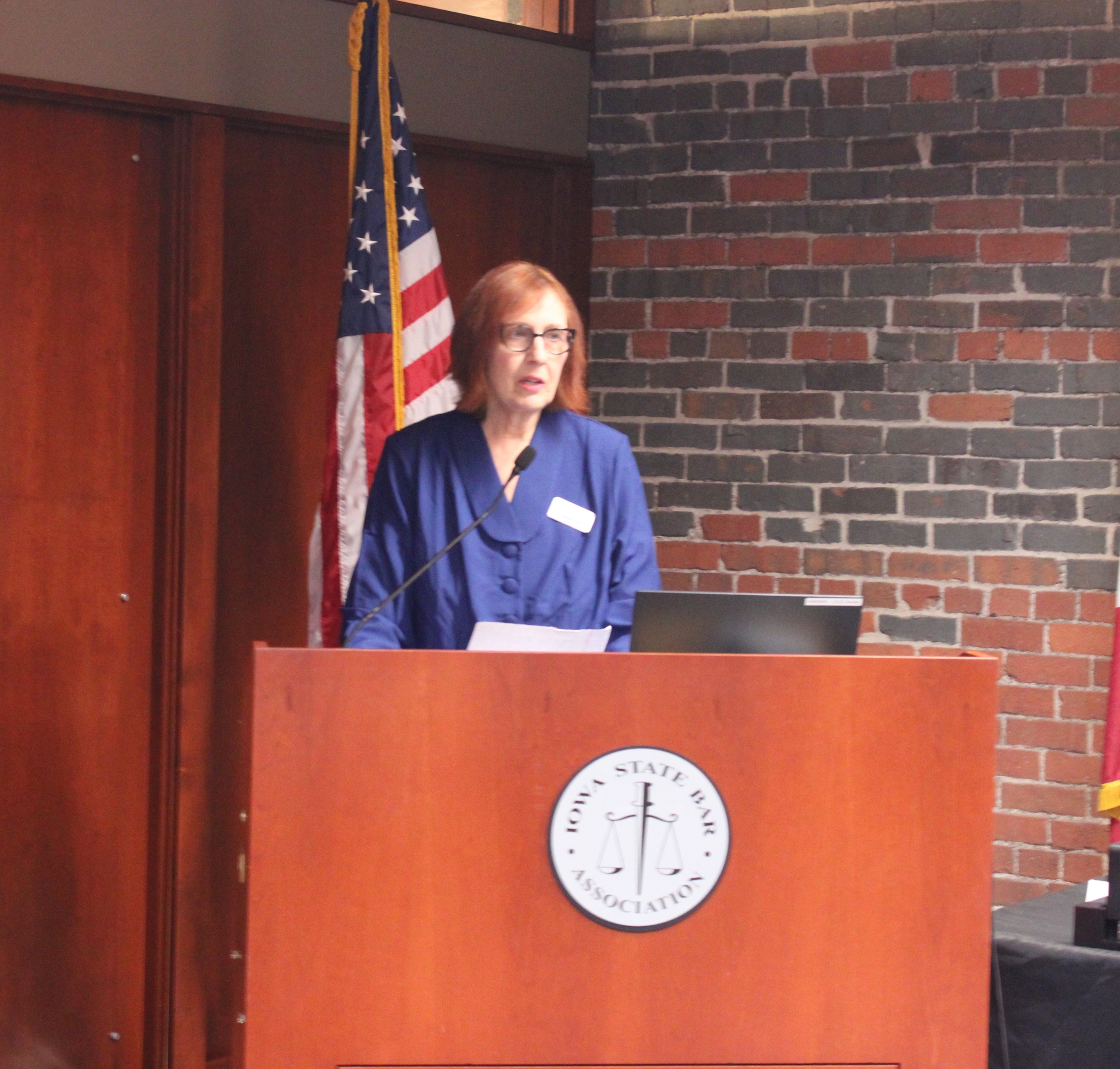
ISBA President Kathy Law provides a President's Report to the ISBA Board of Governors on Dec. 10
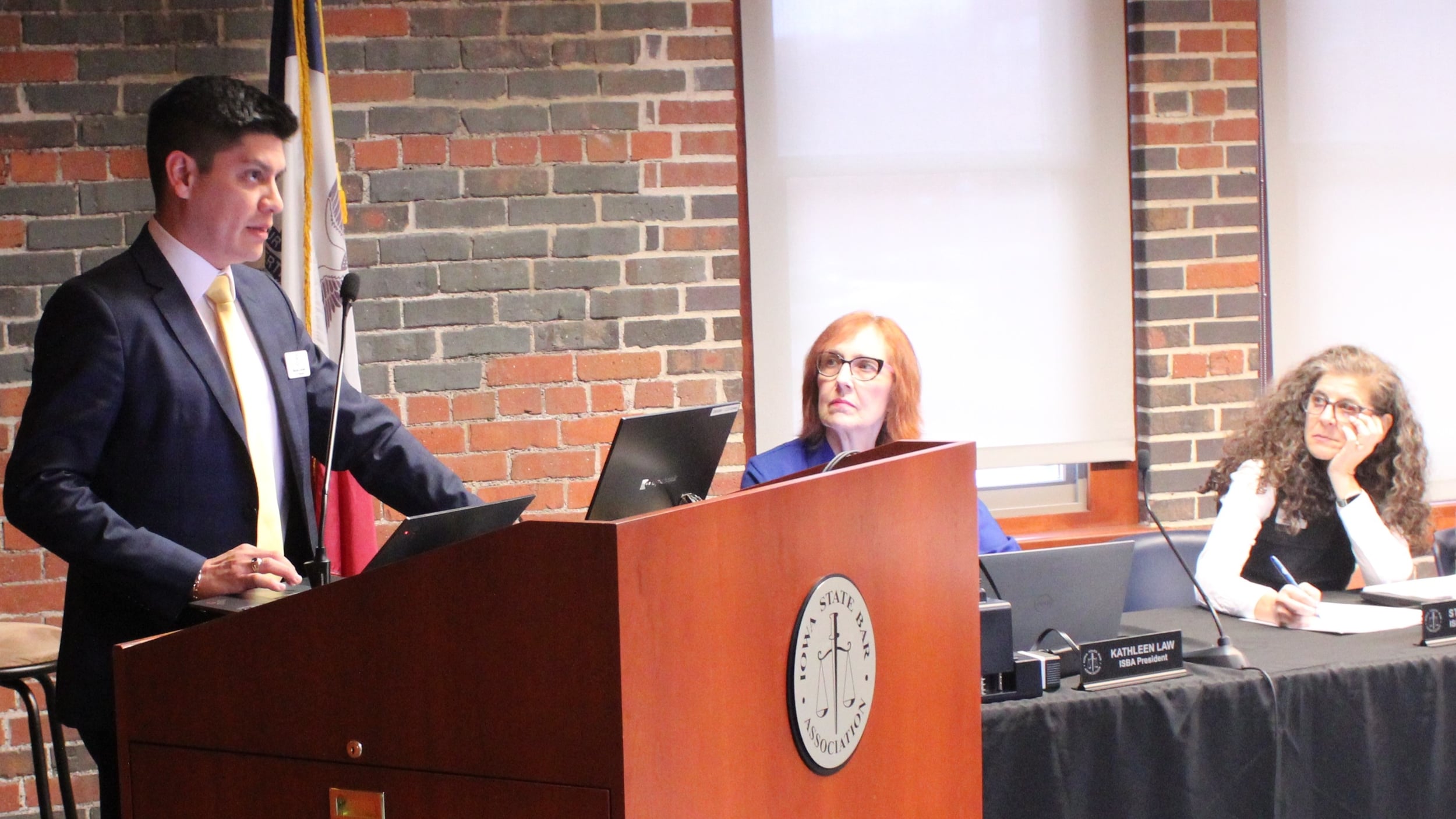
ISBA Young Lawyers Division President Manuel Cornell gives an update to the board on the division's activities
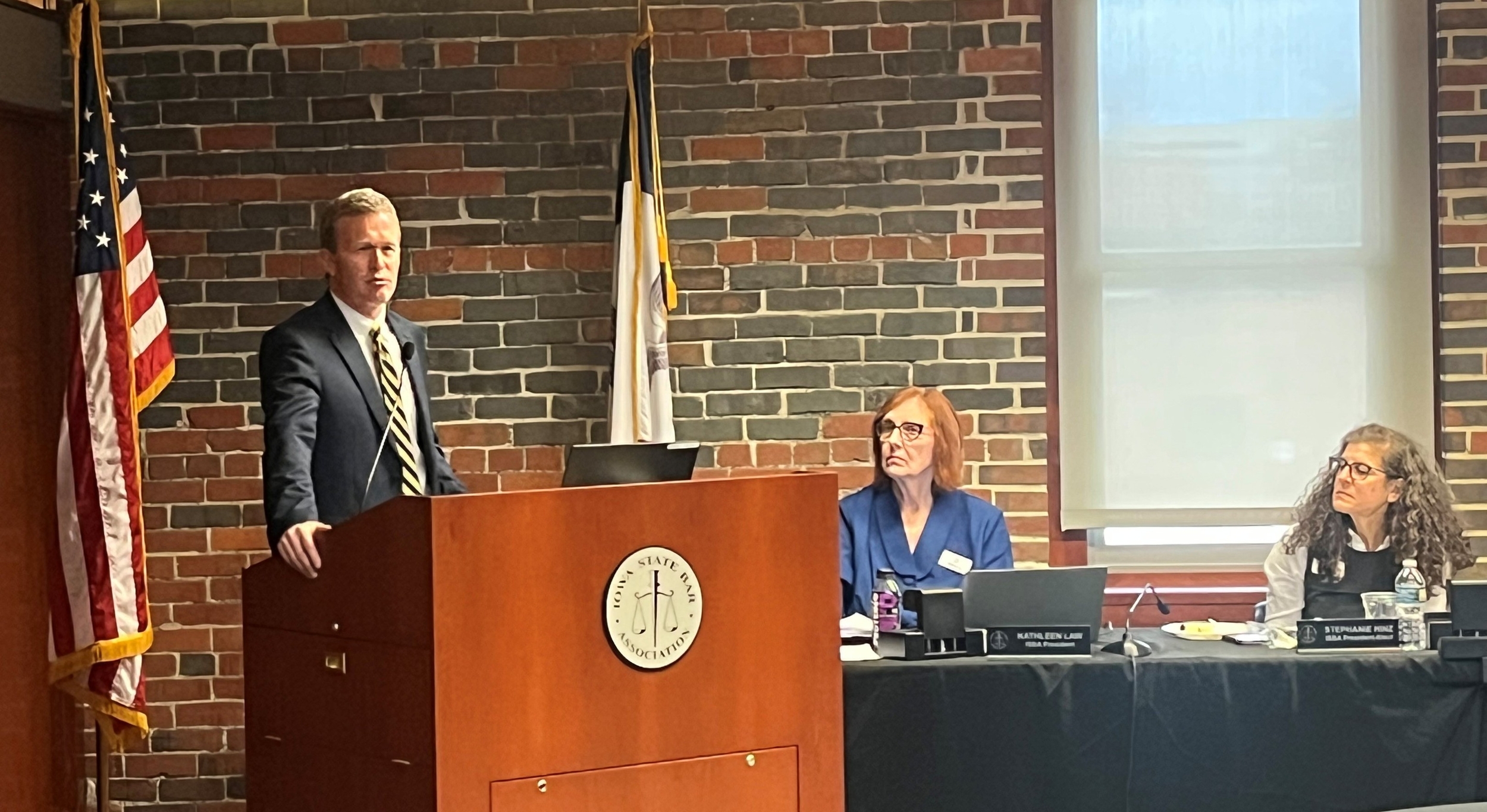
University of Iowa College of Law Dean Todd Pettys provides an update to the board. Also pictured are President Kathy Law and President-elect Stephanie Hinz
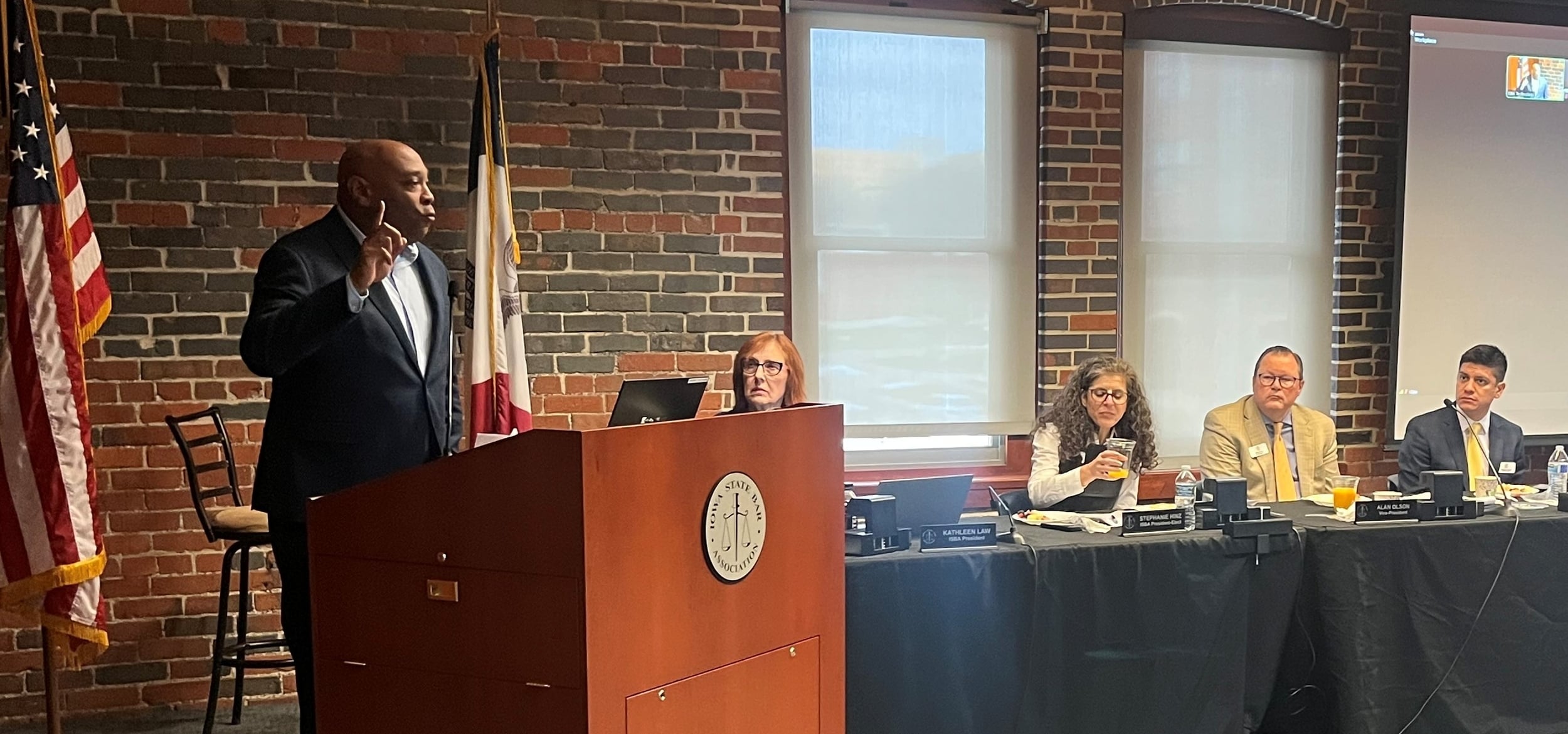
Drake University Law School Dean Roscoe Jones, Jr. delivers remarks at the ISBA Board of Governors meeting. Also pictured are ISBA President Kathy Law, President-elect Stephanie Hinz, Vice President Alan Olson, and YLD President Manuel Cornell

The ISBA Board of Governors connected over dinner on Dec. 9 at the Iowa Tap Room in Des Moines

ISBA President Kathy Law and her trivia teammates, including Board of Governors member Jennifer Harrington (far-left) won prizes for their trivia knowledge at the board dinner
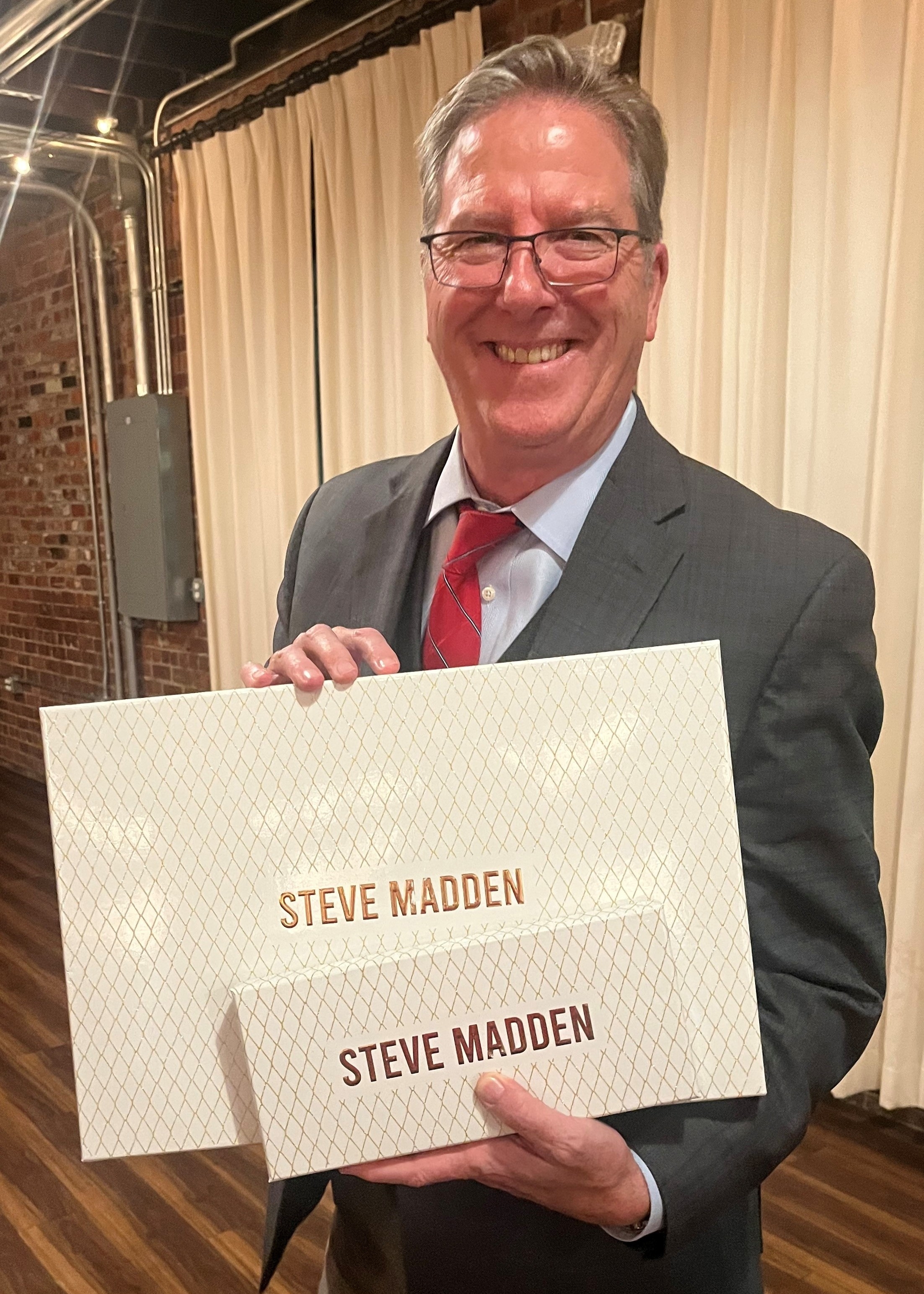
ISBA Solo Small Firm Section Chair Mark Gray was a trivia prize winner
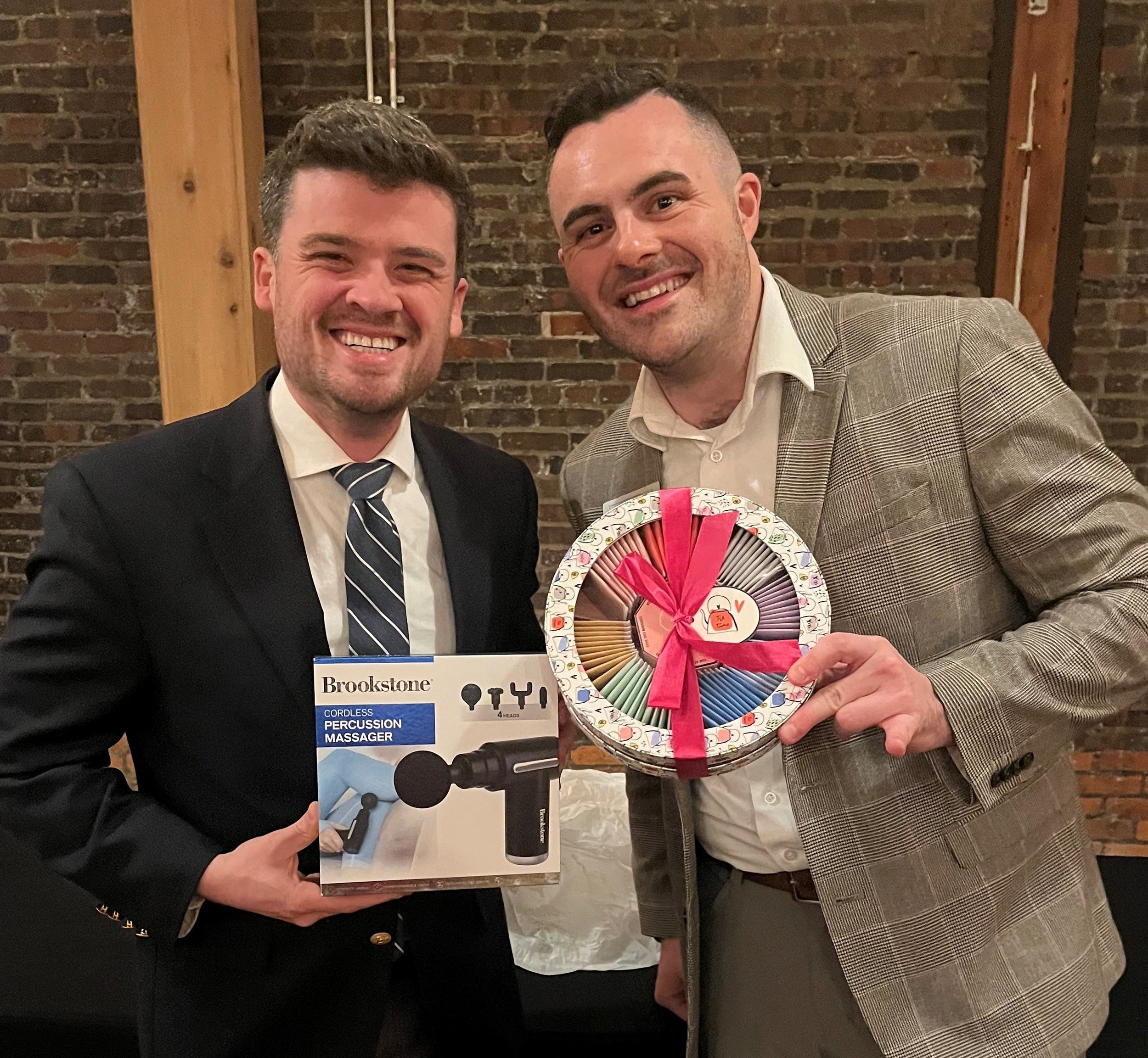
ISBA Young Lawyers Division Secretary Peter Johnson and Vice President Aaron Jones won trivia prizes during the winter board dinner
Visit the Iowa Bar Blog for more news.


