By Jerry L. Schnurr III, ISBA Past President 2020-2021
The Iowa Supreme Court has been ahead of the U.S. Supreme Court in civil rights decisions throughout history. Here are some highlights of a few specific cases in which the Iowa Supreme Court decisions were later adopted by the U.S. Supreme Court and implemented at a national level.
In Re Ralph, July 4, 1839
In 1839, the Iowa Supreme Court’s first decision forbade slavery in the case of In Re the Matter of Ralph. Ralph was an enslaved person who lived in Missouri with his enslaver, a Missouri resident named Jordan Montgomery.
In 1834, Montgomery provided written permission for Ralph to reside in Iowa. Ralph was ordered to work for pay in the Iowa territory. Once he earned $550 plus interest, he was to pay that money to Montgomery to procure his freedom. That same year, Ralph traveled to Dubuque and began working in the lead mines. Ralph lived in Dubuque for over five years but made no payments back to Montgomery.
Still residing in Missouri, Montgomery hired a pair of bounty hunters to abduct Ralph and return him to enslavement in Missouri. The bounty hunters sought and obtained a warrant to seize Ralph from a Dubuque court claiming he was a fugitive slave. The agents found and captured Ralph, but a fellow miner named Alexander Butterworth sought a writ of habeas corpus on Ralph’s behalf from the Iowa Supreme Court. The presiding justice, Justice Wilson, ordered that Ralph be removed from the boat the bounty hunters took him to for the trip back to Missouri and held in custody until the matter could be resolved. On July 4, 1839, the Supreme Court ordered Ralph to pay the money still owed Montgomery - the sum of $550 plus interest - but ruled he could not be returned to slavery while living in the free state of Iowa. By allowing Ralph to leave Missouri and reside in Iowa, the court declared that Montgomery could no longer claim dominion over the former slave.
The Missouri Compromise of 1820 admitted Missouri as a slave state and Maine as a non-slave state. It attempted to strike a balance between slave and free states by outlawing slavery in northern territories of the Louisiana Purchase, including Iowa.
Iowa Supreme Court Chief Justice Charles Mason stated, “The master who, subsequently to that act permits his slave to become a resident here, cannot afterwards exercise any act of ownership over him within this territory. The law does not take away his property in express terms but declares it no longer to be property at all.”
Chief Justice Mason went on to say, “When he [Montgomery] applies to our tribunals for the purpose of controlling, as property, that which our laws have declared shall not be property, it is incumbent on them to refuse their cooperation. When in seeking to accomplish his object, he illegally restrains a human being of his liberty, it is proper that the laws, which should extend equal protection to men of all colors and conditions, should exert their remedial interposition. We think, therefore, that the petitioner should be discharged from all custody and constraint and be permitted to go free while he remains under the protection of our laws.”
This document is the written judgment from Iowa Supreme Court Chief Justice Charles Mason:
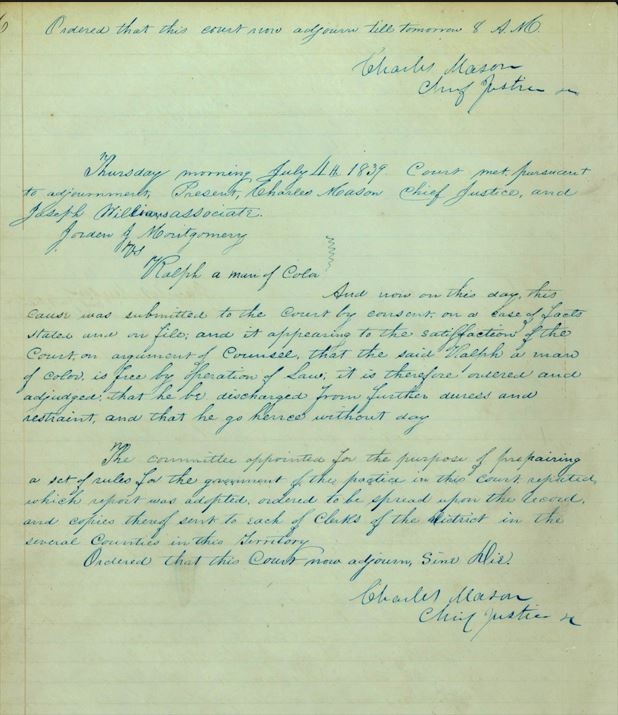
Courtesy of State Historical Society of Iowa, Mason, Charles, 1839
Clark v. Board of Directors, 1868
In 1868, the Iowa Supreme Court rendered one of its great civil rights decisions in Clark v. Board of Directors (24 Iowa 266). Susan Clark, a 12-year-old African American, was not allowed to attend the school in her Muscatine neighborhood because it was for whites only. The Iowa Supreme Court held that racial segregation of public schools was unconstitutional under the Natural Rights/Equality Clause of the Iowa Constitution’s Bill of Rights (1857 version). This courageous decision, authored by one of Drake Law School's founders, Justice Chester Cole, preceded both the ratification of the Fourteenth Amendment to the U.S. Constitution and the November election in which Iowa voters passed the amendments to the Iowa Constitution deleting racial designations and granting blacks the right to vote. Moreover, Clark, the first court decision in the nation to reject "separate but equal" in public education, preceded the U.S. Supreme Court decision Brown v. Board of Education by 86 years.

Iowa Supreme Court Justice Chester C. Cole (1874-1876). Image provided by the Iowa Judicial Branch.
Coger v. North Western Union Packet Co., 1873
Emma Coger was a 19-year-old seventh-grade teacher at a segregated school in Quincy, Illinois in 1872 when a trip to Keokuk, Iowa, changed her life.
Returning home from visiting friends, she boarded a steamboat in Keokuk and attempted to purchase a first-class breakfast ticket and was denied because she was of African ancestry. Ms. Coger obtained a ticket from another passenger which allowed her to eat in the dining room. An attempt by Coger to be served dinner later resulted in a scene where an attempt to forcibly remove her from the dinner table was unsuccessful. She subsequently hired the law firm of McCrary, Miller, and McCrary (Keokuk) and sued the North Western Union Packet Company in Iowa’s district court in Lee County. Assault and battery were the official charges.
The verdict was in Coger’s favor, and she was awarded $250. She was quoted as saying that she had not sued for the money, but “to vindicate the rights of my race, and my character of womanhood.” The defense appealed and filed a motion for a new trial. The laws of Iowa and the U.S. Constitution secured Coger’s rights, and the verdict was upheld in the Iowa Supreme Court.
State v. Katz, 1949
M. C. Katz was charged with the crime of infringement of the civil rights of John Bibbs, an African American, by refusing to serve him, Edna Griffin, and Leonard Hudson at the soda fountain in Katz Drug Store in Des Moines.
According to the Iowa Civil Rights Act of 1884, all persons within Iowa shall be entitled to the full and equal enjoyment of accommodations, advantages, facilities, and privileges of inns, restaurants, lunch counters, theaters, public conveyances, etc. Anyone who denies to any person, except for reasons applicable to all persons, the full enjoyment of any of the accommodations, or by aiding or inciting such denial is guilty of a misdemeanor.
The State’s evidence included a Katz Drug Store waitress who stated, “We don’t serve colored people.” Other evidence involved Mr. Gore, the fountain manager at Katz Drug Store, proclaiming, “It is the policy of our store that we don’t serve colored; we don’t have the proper equipment.” Mr. M.C. Katz, the store’s general manager was quoted saying, “I cater to a large body of white trade and don’t have the proper equipment to serve you.”
The defense told a narrative about three Black people creating a disturbance, and when a disturbance is created, whether they be White or Black, “we don’t serve them.” The defense theory was submitted to the jury in its instructions and the jury returned a guilty verdict against the defendant. The denial of service was for reasons not applicable to all – their race.
Katz Drug Store at 7th and Locust in Des Moines in about 1940. Photo from Outside In: African-American History in Iowa, 1838–2000, ed. Bill Silag et al. (Des Moines, 2001), 77.
The practice of discrimination at Katz Drug Store did not change for some time after the court decision until it felt the economic impact of pickets, boycotts, and sit-ins. The building at 7th & Locust in Des Moines where Katz Drug Store was located is now named the Griffin Building in honor of Edna Griffin. At the time, Black people generally couldn’t eat in restaurants, stay in hotels, and were relegated to the balconies of movie theaters in downtown Des Moines.
Varnum v. Brien, 2009
Varnum v. Brien was a 2009 Iowa Supreme Court case in which the court unanimously agreed that the state’s limitation of marriage to opposite-sex couples violated the equal protection clause of the Iowa Constitution. The case made same-sex marriage legal in Iowa.
Six same-sex couples applied for marriage licenses with the Polk County Recorder’s Office. The licenses were denied. All met the requirements to marry in Iowa except for the statutory restriction that defined marriage as a union between a man and a woman. The Iowa marriage statute which limited civil marriage to a union between a man and a woman violated the equal protection clause of the Iowa Constitution. According to Article I, Section 6, “All laws of a general nature shall have a uniform operation; the General Assembly shall not grant to any Citizen, or class of Citizens, privileges or immunities, which, upon the same terms shall not equally belong to all Citizens.”
About the author:

Jerry L. Schnurr III served as the 134th ISBA president during the 2020-2021 fiscal year. Jerry is also a co-chair of the ISBA Sesquicentennial Committee. He is a solo practitioner at Schnurr Law Firm P.C. in Fort Dodge.


