By Kelcy Whitaker
The Honorable Robert W. Pratt of the U.S. District Court for the Southern District of Iowa hung up his robe after a marathon 26 years and two months on the federal bench and transitioned to inactive status on Sept. 1, 2023. Judge Pratt was nominated to the bench by President Bill Clinton on Jan. 7, 1997, to replace the seat vacated by the Honorable Harold D. Vietor. He was confirmed by the U.S. Senate on May 23, 1997, and received his commission on May 27, 1997. Judge Pratt was sworn in on July 1, 1997. He served as Chief Judge from 2006 to 2011 and assumed senior status on July 1, 2012.
Judge Pratt was born in 1947 to parents Gregson Maurice Pratt and Laura Margaret Dunkelberg Pratt. He grew up with his brother and two sisters on a small family farm near Emmetsburg. Greg was a farmer, and Margaret worked with the Iowa State University Extension Service until she was confronted with mandatory retirement. Margaret, who was always helping someone, then joined the Peace Corps at 66 years old. She was “the glue that held the family together” and was way ahead of her time—she fervently believed in equality and civil rights and passed her beliefs, as well as her grit and determination, on to her children.
Judge Pratt attended Loras College in Dubuque where he met Rose Mary Vito, a student at Clarke College. After graduating from Loras in 1969, Judge Pratt studied at Creighton University School of Law in Omaha, Nebraska, while Rose Mary, who had earned a teaching degree from Clarke, taught in the Twin Cities. They married in August 1971 and together have three children and nine grandchildren. Of all his successes in life, Judge Pratt is most proud of his marriage to Rose Mary and his family.
Judge Pratt graduated with a J.D. from Creighton in 1972, and they relocated to Rose Mary’s hometown of Des Moines. His first job after law school was with the Legal Aid Society (now Iowa Legal Aid), where he represented low-income clients in housing, dissolution, consumer, and civil rights cases until 1975. He worked with several other lawyers who would greatly influence his career, including Bob Oberbillig, his boss at Legal Aid, who devoted nearly his entire career to serving low-income people and who believed low-income clients were entitled to the same quality representation that others had. Among many lawyers who were employed at Legal Aid during his time there were Tom Harkin, Alfredo Parrish, Jim Meade, and others from whom Judge Pratt learned many valuable lessons.
In 1975, he transitioned to private practice and shared office space with Jim Brick and Charlie Funaro. Judge Pratt began representing organized labor and also served as a court-appointed criminal defense attorney. He tried 25 criminal cases to verdict in Polk County and three in federal court. In 1978, Judge Pratt moved with Funaro and Brick to the Hedberg Law Firm and his practice began focusing on workers’ compensation, personal injury, and social security disability cases. His practice grew substantially with the cutback in legal services funding and the mass terminations of the benefits for disabled persons by the Social Security Administration. His colleague Art Hedberg once remarked that Judge Pratt was “the only lawyer to have left Legal Aid and gotten poorer clients.” Judge Pratt started his own firm in 1985 and developed a successful practice, which he maintained until his appointment to the bench.
Judge Pratt argued his first case before the Iowa Supreme Court in 1975 as an attorney for Legal Aid. In all, he argued 25 cases before the Eighth Circuit and 10 cases before the Iowa appellate courts as an appellate advocate. The case he is most proud of as a lawyer is Alexander v. Employment Appeal Board, in which the Iowa Supreme Court ruled for locked-out workers during a labor dispute.
In 1997, Judge Pratt’s former Legal Aid colleague Senator Tom Harkin recommended him to President Clinton. At his confirmation hearing, Senator Harkin remarked that Judge Pratt “is one of the best public-interest lawyers in the country” and that “[h]is respect for the rule of law and his faith in our country’s system of justice is inspiring.” Senator Harkin continued, proclaiming that Judge Pratt “has the temperament, the intellectual rigor, the compassion, and the ability to be a fair and impartial judge.” These words were true before Judge Pratt ascended to the bench, and they undoubtedly remain true today after more than 26 years as a federal judge.
As a trial court judge, Judge Pratt presided over more than 150 cases that went to verdict. Watching lawyers do their work and zealously represent their clients greatly benefited him as a judge, and he was always impressed with the quality representation that attorneys appearing before him provided. Judge Pratt even had the opportunity to observe and learn from legendary trial lawyer Gerry Spence who tried a six-week civil rights case in his courtroom. Judge Pratt did not fear reversal. He focused instead on “getting the law right.” This principle shone through in his most notable decisions. In the Prison Fellowship Ministries case, Judge Pratt held that a Christian rehabilitation program that operated in Iowa’s prisons with the aid of public funding violated the First Amendment. His principled position regarding the importance of not tolerating public corruption was demonstrated when he sentenced former Iowa State Senator Kent Sorenson to a period of incarceration despite the recommendation of the U.S. Attorney’s Office. And for 10 years he kept the interests of the public in the forefront of his mind while presiding over the clean-up of the Dico superfund site. Following the First Step Act of 2018, Judge Pratt was one of the first judges in the nation to consider a prisoner’s motion for compassionate release submitted directly to the district court in Brown v. United States. He granted dozens of compassionate release motions, undoing many needlessly harsh sentences in the process. More recently, Judge Pratt upheld the law in a case brought on behalf of vulnerable disabled school children when schools asked students and staff to wear masks in the early days of the COVID-19 pandemic.
Judge Pratt’s ability to be a fair and impartial jurist was on full display in his sentencing decision in the underlying case of the U.S. Supreme Court’s Gall v. United States. Judge Pratt’s decision to sentence Gall, who was a college student at the time of his offense, to a three-year term of probation rather than a guidelines sentence of 30 months’ imprisonment was “right” under the law post-Booker, which had held that the federal sentencing guidelines were advisory, not mandatory. The Eighth Circuit disagreed and reversed. In a landmark case, the U.S. Supreme Court reversed the Eighth Circuit and held “that the sentence imposed by the experienced district judge in this case was reasonable.” Gall, 552 U.S. 38, 41 (2007). The Supreme Court’s decision in Gall sent waves across the country and continues to be cited today. As Senator Harkin observed after Judge Pratt took senior status in 2012: “The Gall case gave to judges the power to weigh different factors in determining fair and just sentences, as opposed to some mechanical formula. In other words, judges should judge!”
Sentencing was by far the most difficult of Judge Pratt’s duties as a district court judge. It involved extensive knowledge of the applicable guidelines and relevant laws, but also an incredible resolve to do justice as well a good deal of compassion—for the victims and their loved ones, the defendant, and the defendant’s family. It is not easy to sit in judgment of a fellow human, and it was a heavy burden for Judge Pratt to bear. He heeded Judge Richard Arnold’s advice regarding sentencing and tried not to lecture defendants because it was unnecessary and, by lecturing, the judge presumed he or she was morally superior to the defendant. As Judge Arnold wrote, “The mere fact that the judge has obtained a Commission from the President is not evidence of that superiority.” At nearly every sentencing hearing, Judge Pratt invited the defendant to come to the courthouse to visit him upon release from prison to share his or her experiences in federal prison and their goals for the future. Some took him up on his offer, and Judge Pratt appreciated their candor and hoped for their success.
Judge Pratt led many initiatives in the Southern District, including working closely with the U.S. Probation Office to establish a criminal re-entry court. As a judge, he initiated a re-enactment of the arguments before the Supreme Court in Brown v. Board of Education for the 50th anniversary of that May 1954 decision. Young area students attended and were able to learn about that decision, which was followed by a discussion of the importance of education by then-Chief Justice of the Minnesota Supreme Court Allan Page. Judge Pratt served on the Eighth Circuit’s Model Jury Instructions Committee for many years and the IT Committee for the entire federal judiciary. He also taught at Baby Judges School in 2010 and 2014 and served as a mentor judge for several newly-appointed judges. Following the Gall decision, Judge Pratt traveled around the country on behalf of the U.S. Sentencing Commission and the Federal Judicial Center and presented programs focused on advocacy in sentencing. He has provided testimony before the Sentencing Commission on multiple occasions. Judge Pratt has also presided over dozens of naturalization ceremonies. For over a decade, he welcomed new U.S. Citizens at special ceremonies held at Principal Park in Des Moines.
Judge Pratt has seen many changes in both the law and the legal profession during his 51-year career. One of the biggest positive changes he has observed in the law is more protection for women who are victims of domestic violence, as there was hardly any protection for them when he worked at Legal Aid. And, for better or worse, he has witnessed a steady decline in civil jury trials. Another big transformation Judge Pratt has witnessed is the influx of women into the legal profession, which he says has been one of the most positive impacts on the profession in his lifetime. Judge Pratt supported initiatives to increase diversity on the federal bench and strived to hire law clerks with varied backgrounds.
Throughout his time on the bench, Judge Pratt mentored thirty law clerks—whom he affectionately referred to as “my lawyers”—and countless interns. He was always well-prepared for oral arguments and read every case cited in his decisions. He often recalled lesser-known holdings and provided clerks with a precise case citation from memory. And always present to lend a helping hand in chambers, regale the law clerks with history lessons and stories of their time in private practice, and of course, tirelessly work on Social Security Disability appeals, was Judge Pratt’s longtime paralegal Mike Messina.
Anyone who has ever appeared before Judge Pratt knows that he values civility in the profession. He required litigators to be respectful both in the courtroom and in their filings. Many have probably heard him quote Rodney King’s “Can’t we all just get along?” Judge Pratt strongly believed that jurors play the most important role in our justice system. He took great care during voir dire to explain to potential jurors their vital role in the process and helped them appreciate the significance of their civic duty. He was mindful and respectful of the jurors’ time and their duties outside of the courtroom to their families and their employers.
When Judge Pratt is not busy traveling with Rose Mary, his wife of nearly 53 years, to visit their children and grandchildren, he is home in Des Moines.

Judge Pratt and Rose Mary at a final party hosted at the courthouse on his last day, Aug. 31, 2023

Judge Pratt pictured with several of his former clerks and the court’s staff attorneys while celebrating his 20th year on the bench in 2017

Judge Pratt with his family in front of his portrait at the courthouse in 2013
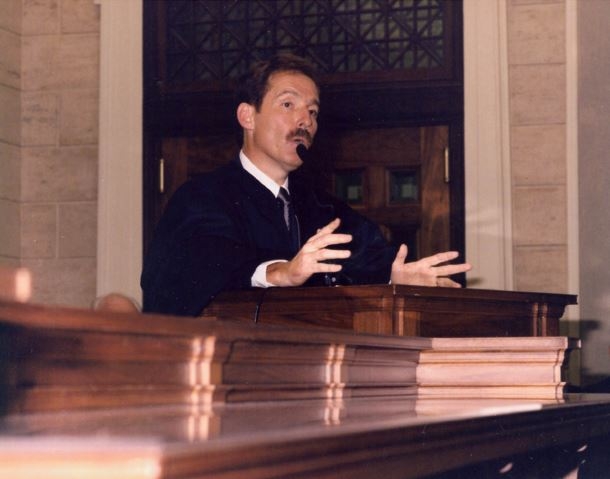
Judge Pratt speaking at his investiture ceremony on July 18, 1997
About the author:

Kelcy Whitaker is a business litigation associate attorney at Fredrikson & Byron, P.A. in Des Moines. She previously served as a career law clerk for the Hon. Robert W. Pratt.


